

Ear tags provide unique identification of sheep
Sheep ear tagging is an essential part of the National Livestock Identification System (NLIS), Australia’s system for identifying and tracing sheep and goats, and is a mandatory requirement in some states in Australia. Producers record all sheep movements in the NLIS database, enabling each sheep to be traced back to its property of birth and its last property of residence.
Legislation for livestock owners (ear tags)
The Biosecurity (National Livestock Identification System) Regulation 2017 also requires livestock owners to identify and track animals to manage major issues such as disease and food-safety incidents, to prevent theft and to assist in recovering stolen animals.
Owners must identify all animals leaving a property with an NLIS-approved device before moving them, unless the state or territory authority issues a permit.
Once an owner tags an animal, the tag should remain with that animal for life. If a tag stops working or falls out and the animal is no longer on its property of birth, the owner must attach an NLIS-approved post-breeder device to maintain the animal’s traceability.
It is an offence to remove an NLIS tag from an animal and apply another tag, unless the animal’s original tag is not working or has fallen out.
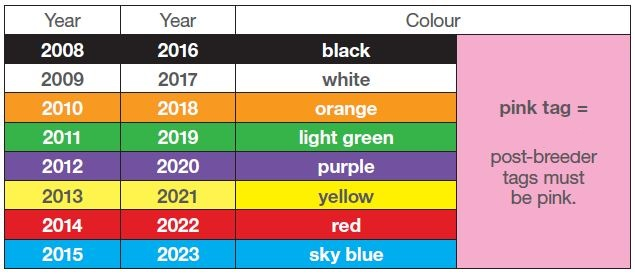
Sheep ear tag colour system
Breeders tag: When a sheep stays on its property of birth, the breeder identifies it with a coloured tag that matches its year of birth. The year-of-birth colour system uses eight colours. Each colour designates a year: starting with black, ending with sky blue, then returning to black for another cycle.
Post-breeders tag: If someone brings a sheep onto a property (i.e., the sheep was not born there), the owner applies a pink tag to show the sheep came from a different owner and does not have “lifetime traceability.”
If a tag is lost or becomes defective, the owner can apply a new tag. However, when the sheep no longer resides on its property of birth, the owner must apply a pink “post-breeder” tag.
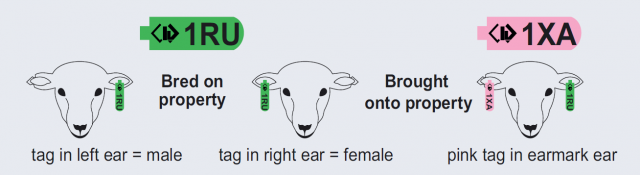
Placement of tags
Owners should place sheep ear tags in the right ear for females and in the left ear for males.
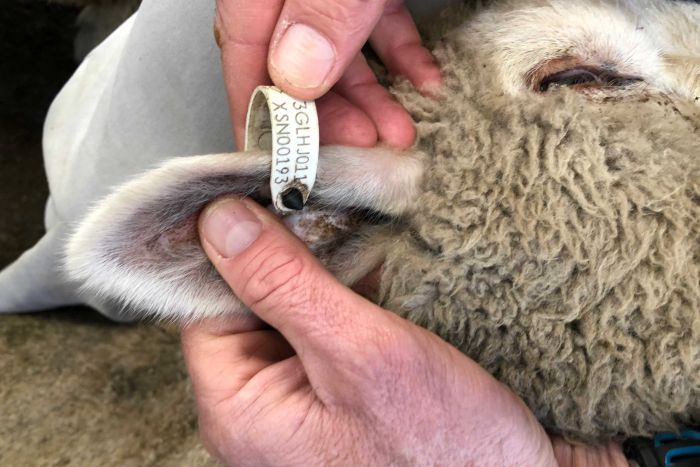
Visual ID (VID) and Electronic ID (EID) Sheep ear tags
There are two types of sheep ear tag identifications -Visual and Electronic (RFID).
They are both identical tags, the only difference is that electronic tags contain a RFID programmed microchip. This chip is embedded into them which allows you to also track your sheep electronically. Both VID and EID tags are either NLIS approved or non-NLIS approved (read below).
Visually, sheep ear tags allow you to identify your sheep by its coloured coded tag on its ear.
They help indicate:
– What year the animal was born (Tag colour system);
– Its gender (tag location);
– Its location of birth through its Property Identification Code (PIC) number.
An EID tag or device contains a microchip that farmers can read electronically in a fraction of a second using a suitable reader or platform. Electronic reading eliminates transcription errors, saves time and labour in the paddocks, and increases the accuracy of information.
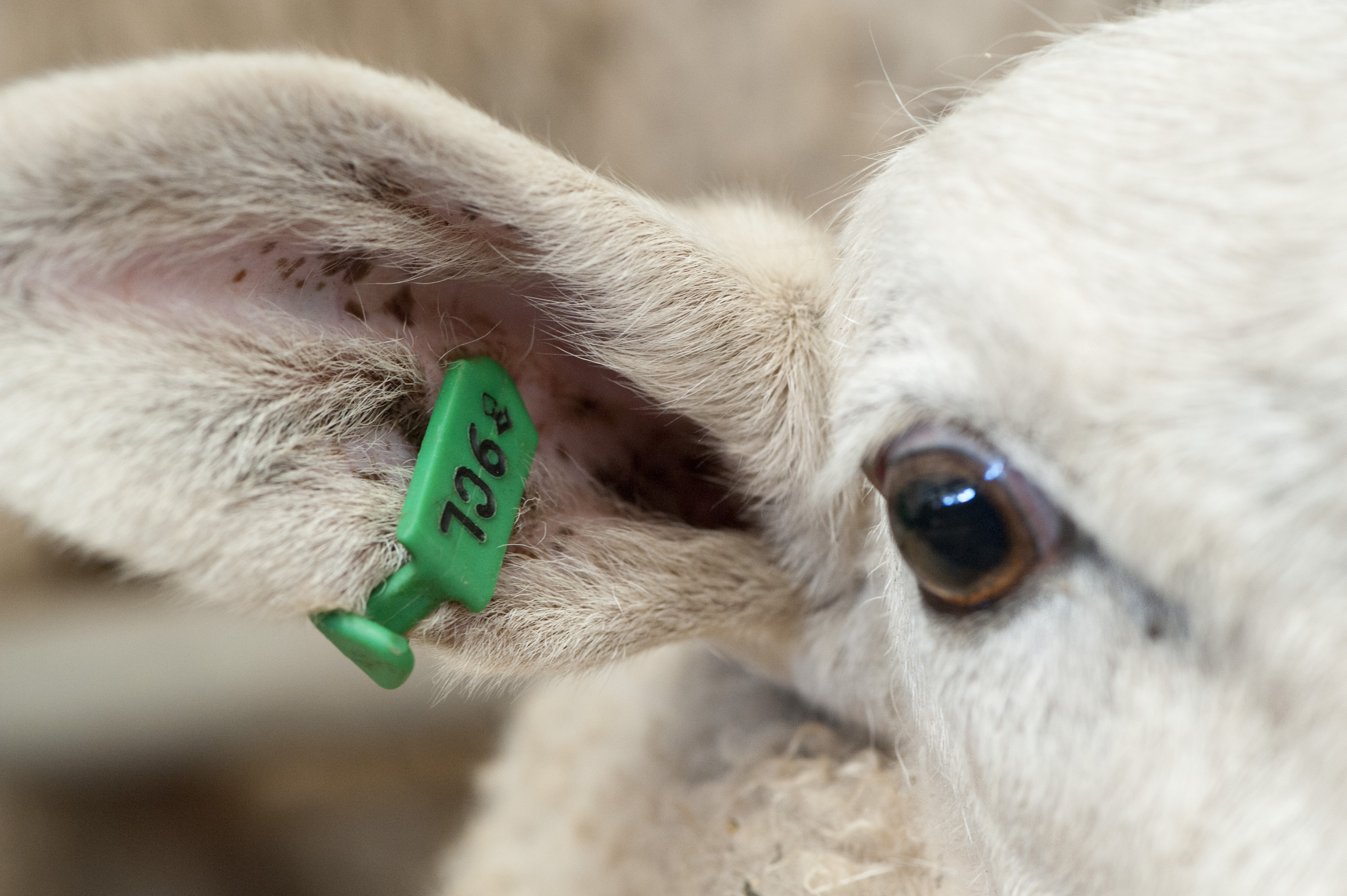
Property Identification Code
All NLIS approved sheep ear tags must include the Property Identification Code (PIC), or company brand in Western Australia. Local Land Services assigns a PIC, a unique eight-character number, to each property with livestock. This PIC is a key piece of information for tracking properties. Producers can trace sheep back to their property of birth. They check the PIC on the animal’s tag against the PIC on the movement document. They also review movements onto and off PICs in the NLIS database.
Every property with livestock must have a PIC, if you do not have one, contact your Local Department of Primary Industries.
How to accurately identify your sheep
Sheep EID system marks each animal with its own, individual identifying number. The EID tag or device can be read electronically in a fraction of a second by a suitable reader. With electronic reading, transcription errors can be eliminated saving both time and labour in the yards. Whilst increasing the accuracy of your information.
Traditionally in the Australian sheep industry, data collection and sheep management occurs on a mob to mob basis. Now with EID and the NLIS system, farmers can manage and monitor each animal individually throughout its lifetime.
Within a flock there substantial variations in the characteristics that influence an animal’s production level. Identifying and understanding these variations provides opportunities to apply selection pressure, or make better informed management decisions throughout the sheep enterprise. Electronic tagging allows these variations to be captured through measuring the performance of individual sheep and for the farmers to apply decisions specific to that individual, reducing costs and labour, while at the same time maximising returns.
Data records
Depending on your own management needs, data records could include:
- Genetics/bloodlines
- Breeding history
- Weight gain
- Vaccine and parasite control history and relevant withholding
- Supplement history
- Fibre diameter measurements
- Pregnancy scanning data.
Data optimisation
With this data, farmers can optimise on:
- Selecting stock for improved current and future production
- Ram and ewe reproduction allocation
- Tracking bloodlines for pedigree matching
- Pregnacy statuses
- Using the weight information to meet market standards
- And more.
Farmdeck's RFID ear tags replaces sheep hand counting
Farmdeck has developed an automated counting and identification system for sheep, removing the need to manually count your sheep every few months. The solution consists of Radio Frequency Identificaiton Devices (RFID) that is carried on ear tags. The RFID sheep ear tags are designed and manufactured by our team, and an electronic reader will be installed on one of your paddock’s gate. The reader can capture the RFID data up to 2km, which is perfect for when you move your sheep from a paddock to another through a gate.
Through the Farmdeck app, you can see exactly which sheep has gone through the gate and which sheep is missing.
Llanelli Farm simplifying daily farm activities
Llanelli Farm in Bathurst were facing challenges with livestock tracking. Every single animal needed to be counted and managed manually once a month; a lengthy and tedious process prone to human error.
Through an all-in-one Farmdeck solution combining network connectivity, sensors, and our app, we enabled Llanelli to track and identify livestock, as well as a number of other challenges they were facing on their farm.
Sheep ear tag information according to your state
-
- NSW/ACT: https://www.dpi.nsw.gov.au/animals-and-livestock/nlis/sheep-goats
- VIC: http://agriculture.vic.gov.au/agriculture/livestock/national-livestock-identification-system/nlis-sheep-and-go
- QLD: https://www.business.qld.gov.au/industries/farms-fishing-forestry/agriculture/livestock/nlis/approved-devices-tags
- SA: &amp;amp;amp;amp;amp;amp;amp;amp;amp;lt;a href=”https://pir.sa.gov.au/biosecurity/animal_health/sheep/nlis_sheep_goats”>https://pir.sa.gov.au/biosecurity/animal_health/sheep/nlis_sheep_goats</li>
<l
i>NT : <a class=”yoast-text-mark”>ef=”https://nt.gov.au/industry/agriculture/livestock/brand-and-identify-livestock/nlis-in-the-nt”>https://nt.gov.au/industry/agriculture/livestock/brand-and-identify-livestock/nlis-in-the-nt
- WA: https://www.agric.wa.gov.au/livestock-biosecurity/nlis-and-identification-sheep
- TAS: https://dpipwe.tas.gov.au/agriculture/animal-industr
- ies/identifying-selling-moving-livestock/buying-selling-sheep-and-goats/nlis-for-sheep-goats